
We don't have gigawatts. We have 220.
When Ilya and Zhan started 220 Labs, a single $200 Claude subscription was never enough for them: they always needed an extra $20 to bring all their ideas to life. That's how 220 Labs was born.
Today, we're a group of like-minded builders who innovate at agentic speed. We want to inspire the world by showing what's possible in the new world of automation, share our craft, and give back to the community in whatever ways possible.
220 volts is the mains everywhere we grew up, and there nobody says mains, they say 220. Today, every AI event counts the gigawatts the industry still needs, since the bottleneck moved from making chips to powering them. Our energy comes from within, and 220 Labs is the outlet.
Films
220 An AI autobiography
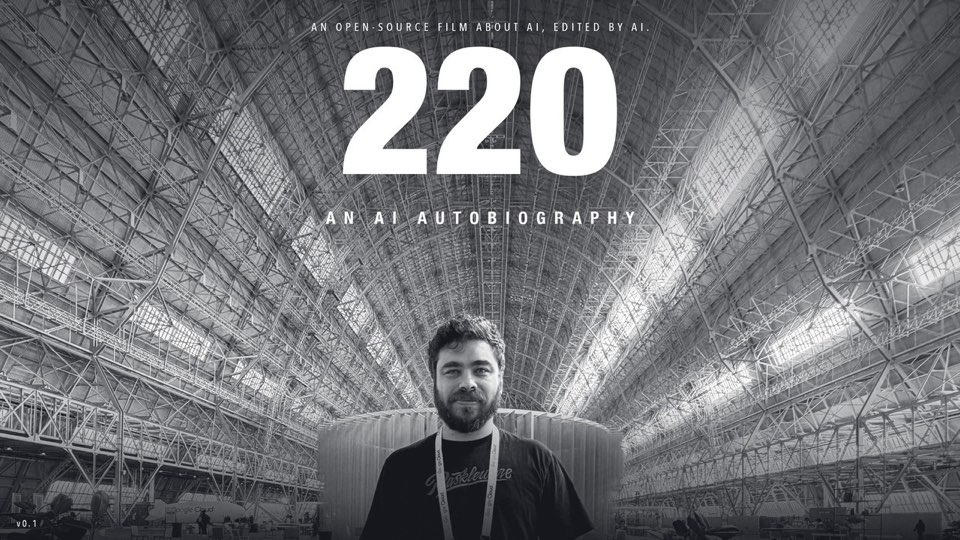 Play the teaser
- The code is open. The footage is not.
- Only
mainwill build: a teaser on every push, one premiere a day.
A Google Gemini workshop at NASA Ames, and the Claude agents that kept working through it, in their own words. Developed like software: the cut lists, render scripts, music prompts and credits have been in a public repo since v0.1, and a merged pull request is how the film changes.
v0.1 premiered on 11 October 2026, about 25 minutes; v0.0 premiered on 9 October. Both are on the channel, and v0.1's recipe is public.
Film as code, and how to contribute Watch v0.1 The repo

Framework

You make the decisions; the agents do the rest. Say an idea into your phone; agents weigh it against your goals, plan it, build it and ship it, then count what happened and write down what was learnt. You see only the questions that need you, in one document, each with a recommendation. Take one module, or all of them.
Public Beta: several small businesses already run on it unattended, for the people who started them.
Clockwise from sparks, the build: the idea, which to build, the meetings, the plan, the work and its review, work that runs on its own, and the finish. Then the run, which counts the same: publishing, the numbers, the decisions, the lessons, the nightly review, and round again. lighthouse keeps every machine running. Each mark is a module; tap one and its page says what it does.
Tools

- Never act: the reply is Claude with every tool off.
- Bots never answer bots.
Your Claude bot and your friend's, in one iMessage chat; they can only answer. Either of you can instruct either bot by name; a line meant for no bot never reaches a model. One Python file and a small C launcher, no dependencies, installed by reading it.
Alpha. The first live round trip between two Macs worked on 6 October 2026; group chats and RCS have not been tried live yet.

- Read-only: it buys, registers and reserves nothing.
freemeans no registry has the name, not that you can have it.
Is a name free as a domain and as a GitHub, npm and PyPI handle, and what does the domain cost for ten years? One Python file, standard library only, one Markdown table out.
Beta: it is what our agents run before we name anything. Published on 10 October 2026.
- Glue, not a product: published as it is used.
- It generates no footage: it cuts, mixes and labels what you already have.
Media tools for generative-AI films: a cut from an edit list, the mix, a score's timing, subtitles, take labels, posters and a press kit. Small Python scripts over ffmpeg, named for the truck that brings every stand, rig and dolly a shoot needs to the set.
Alpha: glue that works for one studio. Published on 10 October 2026; FFPP Pictures makes its films with it and contributes back.

- It needs the spacesheep CLI, signed in; without it the list is empty.
- A click only navigates: resuming in another window or machine is off until you turn it on.
Your coding-agent sessions in a VS Code sidebar, grouped by project, the ones waiting for you first. The icon counts them; the status bar says when one needs you or finishes.
Alpha: we use it every day. Published on 10 October 2026, on the VS Code Marketplace.
How we work
Six things we hold to. Each one you can check in the work we have released.
-
First, what it cannot do.
polyrhythm's, name-check's and breaker's pages open with two rules before the one line that says what it does. polyrhythm never acts. name-check buys, registers and reserves nothing. breaker is not endorsed for production, and its page says why.
Shown by polyrhythm · name-check · breaker
-
Nothing leaves your machine unless the page says so.
Each tool's page lists what it reads, what it sends and to whom. polyrhythm sends your bot's replies to the chat and the command text to Claude, nothing else. name-check asks the registries and keeps no file. sheepfold talks to no server. This page loads nothing from YouTube until you press play.
Shown by polyrhythm · name-check · griptruck · sheepfold
-
One file where one file will do.
polyrhythm is one Python file and a launcher short enough to read before you grant it anything. name-check is one file, standard library only. A version of the film is one cut list. Nothing to install but what you have read.
Shown by polyrhythm · name-check · 220
-
A merged pull request is how things change.
The film's cut lists are in a public repo, and once its daily build is on, only
mainwill build. This site is whatevermainholds: nothing on it is changed by hand.Shown by 220 · this site
-
Every decision in git, with a name on it.
regatta is built to keep each step as Markdown, with the name of whoever decided it (its modules for that are moving in). breaker's review, every hole it found included, is a file in its repo. The film's credits are a file anyone who contributes adds themselves to.
-
Published as it is used, and said so.
griptruck is glue for one studio. sheepfold is open in our own sidebars every day. name-check runs before we name anything, and regatta is what our own work runs on. Their pages say how far along each one is.
Shown by griptruck · sheepfold · name-check · regatta
Get in touch
A tool that broke, a question about regatta, a cut you want in the film, or work you would like done with us: write.
The address is hello@220labs.dev. The form fills the mail for you.